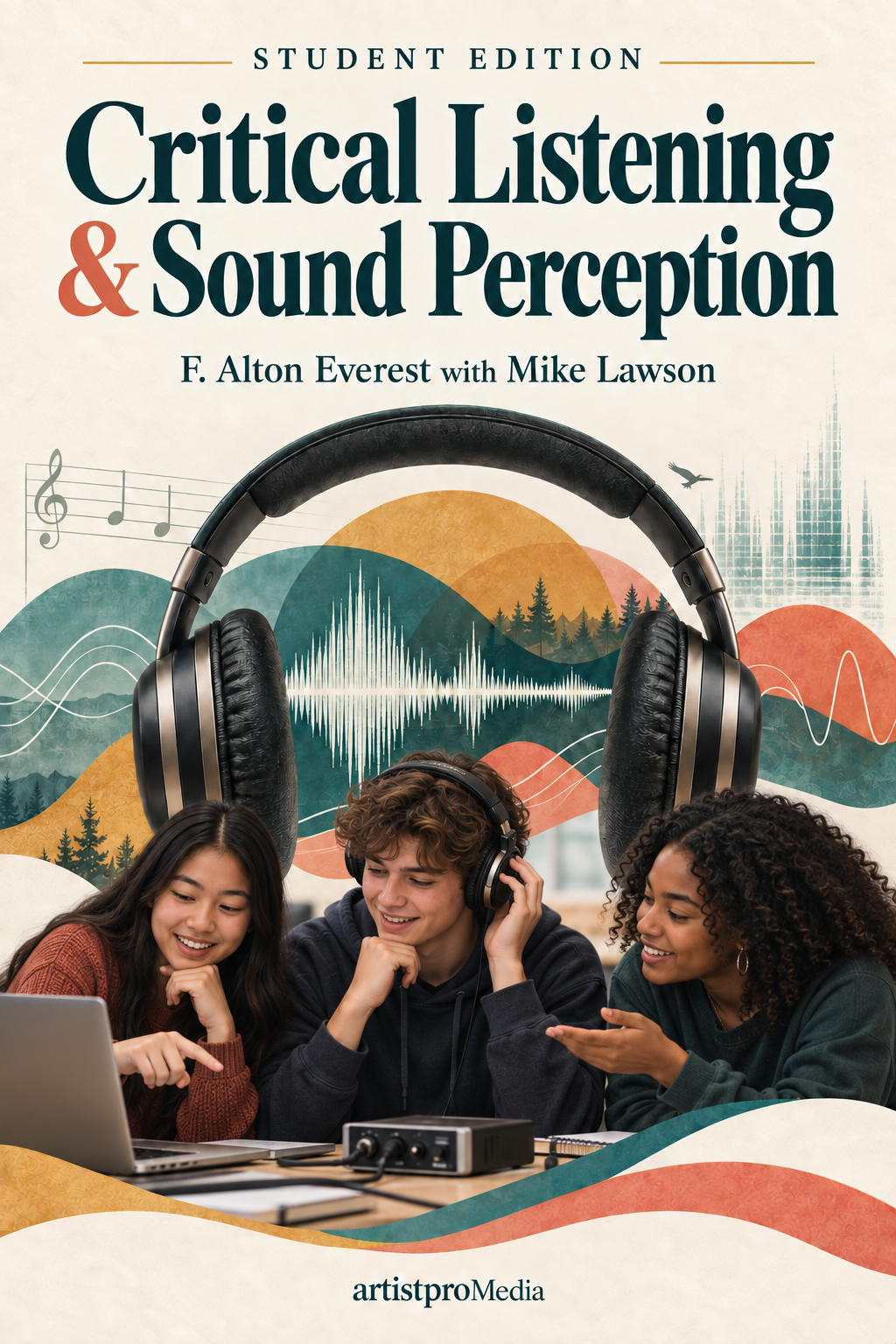
AGES 13–17 · STUDENT EDITION
Critical Listening & Sound Perception
F. Alton Everest with Mike Lawson · artistproMedia
Hear what changes, explain why it matters and make better decisions about sound. Twenty-four practical lessons for ages 13–17, drawing on Critical Listening and Auditory Perception.
Course sequence
- What changed?
- Make a fair comparison
- Same note, different instrument
- The missing note
- Louder, softer, unchanged
- Did louder win?
- Build a sound map
- Find the region
- Where did the bass go?
- Make a radio voice
- Muddy, thin or sharp?
- One adjustment, one reason
- It is there—why is it hidden?
- Make room for the message
- What is underneath?
- Broken—or a sound choice?
- Near voice, far voice
- Move it before you process it
- When does one sound become two?
- A room that helps the words
- Where is the sound?
- Inside or outside the headphones?
- Listening detective: test a theory
- Show your evidence
Included materials
Short listening comparisons, visual explanations, worksheets, downloadable reading, criterion-based assessment and a final portfolio. Teacher-selected DAWs are supported; supplied-file analysis offers an alternative route.
Preview: What changed?
Distinguish observation from preference.
Learn
Critical listening means directing attention toward a question. You might listen for whether words are clear, whether bass overwhelms a voice, or whether two versions differ. An observation describes evidence: “The second version has less low-frequency weight.” A preference reports a choice: “I prefer the second version for this announcement.” Neither sentence automatically proves a fault. Start with a reference, replay a short section and describe one feature. You may say that a difference is uncertain. This course trains a method; it does not rank people by how finely they can hear.
Listen and notice
Play Pair 01 A and B, then Pair 02 A and B. Write one observation before choosing a favorite. Some pairs may be unchanged; do not invent a difference because there are two buttons.
Investigate
- Set playback with the teacher and keep it fixed. Record headphones or speakers.
- Listen to A, then B, using the same section. Replay once if useful.
- Write “I noticed…” and separately “For this purpose I prefer…”.
- Compare descriptions with a partner. Revise one sentence to point to a specific audible feature.
Shared equipment and access
Use the waveform/filter visual after the first observation. Offer written, spoken or diagram responses; no hearing disclosure is required.
Go further
Choose a purpose for which a deliberately thin sound would be useful.
Classroom timing
5 minutes: hear the question. 7 minutes: compare and describe. 8 minutes: name and explain. 20 minutes: investigate with short replays and quiet work between them. 10 minutes: explain, receive feedback and save evidence.
Evidence
Three observations and one preference labeled separately. Use the lesson worksheet. Identify supplied-file analysis, observed demonstration or your own operation accurately.
District adoption and standards
This program provides explicit learning objectives, required evidence, assessment criteria and portfolio review. Each student task is mapped in the district crosswalk. Student and educator standards are reported separately, and local authorities retain decisions about course credit, CTE coding and professional-learning recognition.
View the district adoption guide · Download the lesson-level standards crosswalk