TEACHER PROFESSIONAL DEVELOPMENT
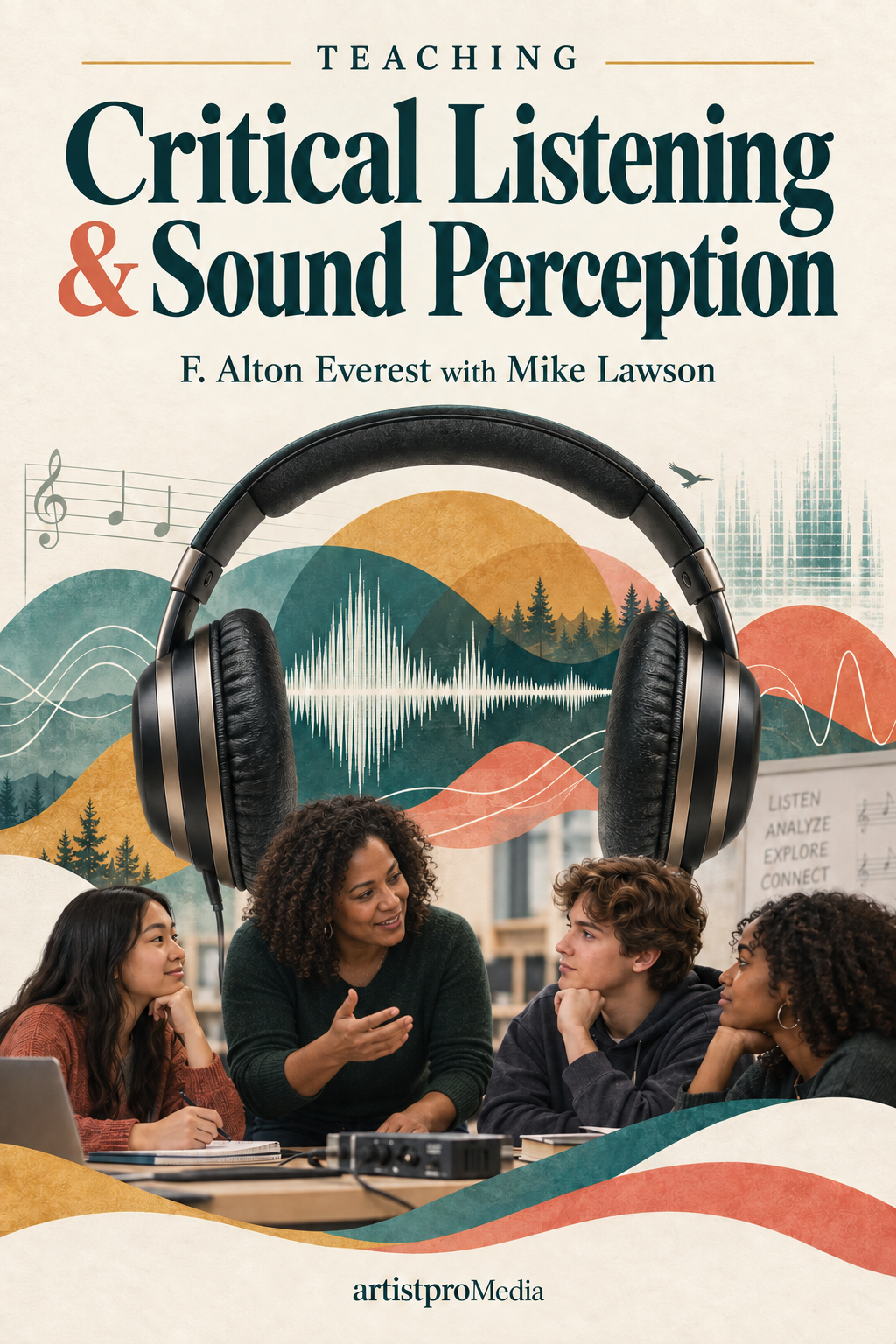
Teaching Critical Listening & Sound Perception
F. Alton Everest with Mike Lawson · artistproMedia
Professional development through listening demonstrations, practice teaching and evidence-based assessment. Prepare to teach the complete ages 13–17 student curriculum in six planned hours.
Course sequence
- Prepare a reliable listening classroom
- Teach sound vocabulary through experience
- Teach filtering and tonal decisions
- Teach masking, noise and distortion
- Teach room and spatial listening
- Assess, adapt and launch
Included materials
Short listening comparisons, visual explanations, worksheets, downloadable reading, criterion-based assessment and a final portfolio. Teacher-selected DAWs are supported; supplied-file analysis offers an alternative route.
Preview: Prepare a reliable listening classroom
Configure playback, check channel orientation, establish repeatable references and provide accessible participation routes.
Study and prepare
- The first teaching task is making comparisons trustworthy. Preview every file on the classroom system, verify left/right channels, disable optional spatial enhancement where possible and record any processing that cannot be disabled. Establish a conservative listening level and provide quiet intervals. Digital file level is not a measurement of exposure at the ear. Never ask a learner to raise playback to make a threshold effect appear.
- For a level exercise, preserve the encoded level difference. For a tonal comparison, use the aligned versions and discuss remaining perceptual differences. Keep source passage, playback control and listening arrangement fixed. Include an unchanged pair so students can answer “no clear difference.” This is a method exercise, not a hearing test.
- Prepare access before instruction: transcript, waveform or spectrum description, replay controls, written or spoken response, paired operator roles and an individual reasoning task. A learner can explain physical signal differences without reporting the same auditory percept as classmates. Do not request public hearing disclosures or alter personal assistive devices.
Demonstration script
- Say: “We are comparing a change, not testing who has the best ears.” Play Pair 01. Ask for a description before a preference.
- Play Pair 02 and accept uncertainty. Ask which variables were fixed.
- Reveal the source relationship after observations. Model a revision: “I expected a difference, but this pair is unchanged.”
Teach, test and revise
- Create a playback/setup checklist for the actual room.
- Teach the five-minute comparison to a colleague or small group; collect one concrete point of confusion.
- Revise your script and prepare an alternative evidence route that preserves the comparison outcome.
Calibration case
Case: Jo reports no difference on an unchanged pair. Sam confidently invents an EQ explanation. The teacher gives Sam more credit for technical vocabulary. Evaluate that decision.
Classroom transfer
Use the complete student reading and instructor teaching guide in the course resources. Plan for student lessons 1–6. Record the available devices, access arrangements and individual evidence route. A student may analyze supplied material without claiming independent operation.
Module timing
10 minutes study, 15 minutes demonstration preparation, 20 minutes teach-back or case work, 10 minutes evidence review, 5 minutes reflection. Record actual active participation separately from these planned minutes.
Evidence
Playback and channel-check notes, the unchanged-pair demonstration, your judgment of Jo and Sam's answers, and one revised instruction after teach-back.
District adoption and standards
This program provides explicit learning objectives, required evidence, assessment criteria and portfolio review. Each educator module is mapped in the district crosswalk. Student and educator standards are reported separately, and local authorities retain decisions about course credit, CTE coding and professional-learning recognition.
View the district adoption guide · Download the lesson-level standards crosswalk